On memory as invention, the streets that cannot be found on any map, and the blue dome that stays while everything else drifts.
There is a street in Tikrit that I cannot find on any map. I have looked. I have walked the old quarter with the painting in my mind, trying to match walls to walls, turns to turns, and the street is not there. It was never there. Or rather, it was there once, in pieces, scattered across a dozen afternoons, and the painting gathered them into a single lane that does not exist.
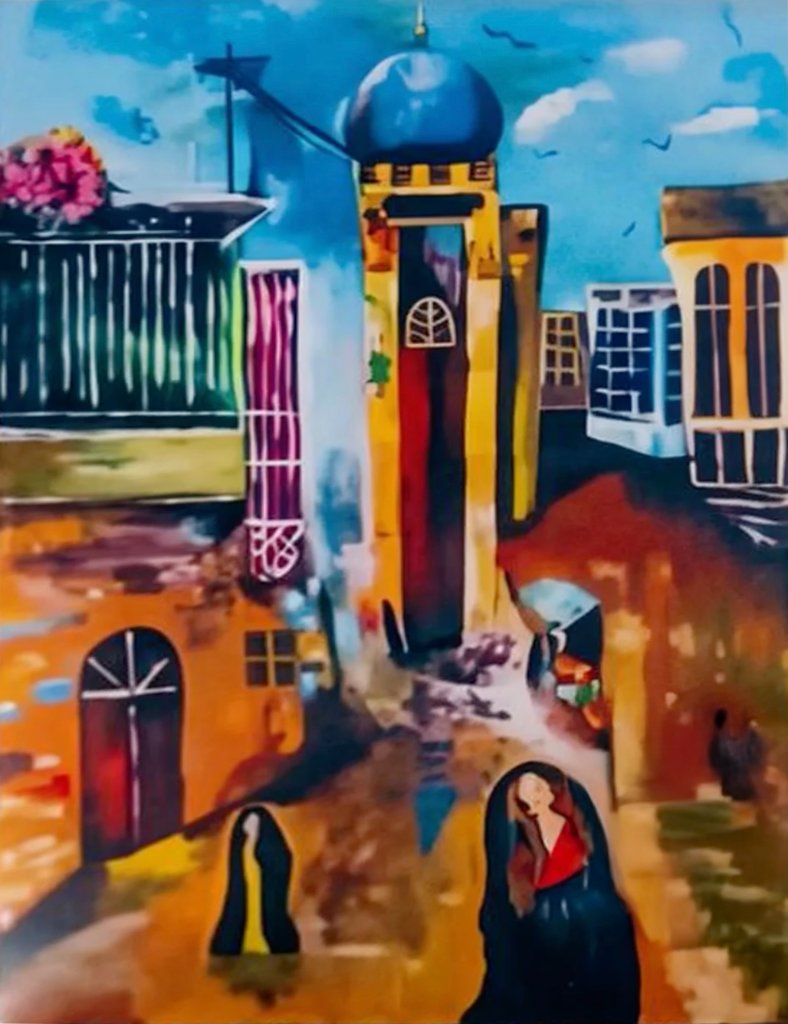
Memory, as the philosopher Henri Bergson understood it, is not a storage drawer. We do not retrieve a memory the way we retrieve a file. A memory is something that happens, an act of the present that reaches into the past and makes something new. Every time I remember the street of my childhood, I am inventing it again. The bougainvillea was probably not that red. The walls were probably not that ochre. But the feeling of the street, the way it pressed close on both sides and opened at the end toward the blue dome, that part is true. Memory keeps the feeling and lets the details drift.
In this painting, color is turned all the way up, past what the eye records and into what the mind insists on. Ochre walls lean toward each other as if listening. Bougainvillea spills over a balcony in a wash of magenta that no photograph would permit. The lane runs back to the minaret, which keeps its blue dome above everything, calm, watching, permanent in a way that the street below is not.
Two women cross the foreground in dark abayas. One glances back over her shoulder. There is a flash of red at her collar. I did not plan that flash of red. It arrived the way memory arrives: unbidden, insistent, carrying more weight than its size. A philosopher might call it a Proustian detail, the small thing that unlocks the whole. For me it is simpler. It is the thing I could not stop seeing, so I painted it, and now it belongs to the street.
Walter Benjamin said that memory is not an instrument for exploring the past but its theater. This painting is that theater. The stage is the lane. The actors are the walls, the flowers, the two women, the minaret. The plot is simple: a place remembered is a place remade. We do not walk back into the past. We build it again, in color, on canvas, and we live inside the reconstruction.
Iraq is a country where the old streets keep disappearing. Wars, rebuilding, neglect, progress, whatever name we give the erasure, the lane from childhood is usually gone by the time you go looking for it. So the painting does the work the street can no longer do. It holds the memory still. Not frozen, not dead, but held, the way a cupped hand holds water for a moment before it slips through.
The minaret is the only thing in the painting that does not move. Everything else leans, spills, glances, drifts. The dome sits above it all in blue, and blue here is the color of permanence, of the thing that stays while the rest of us invent and reinvent the ground beneath our feet. The street is a fiction. The minaret is a fact. The painting lives in the space between them, which is the same space where memory lives.
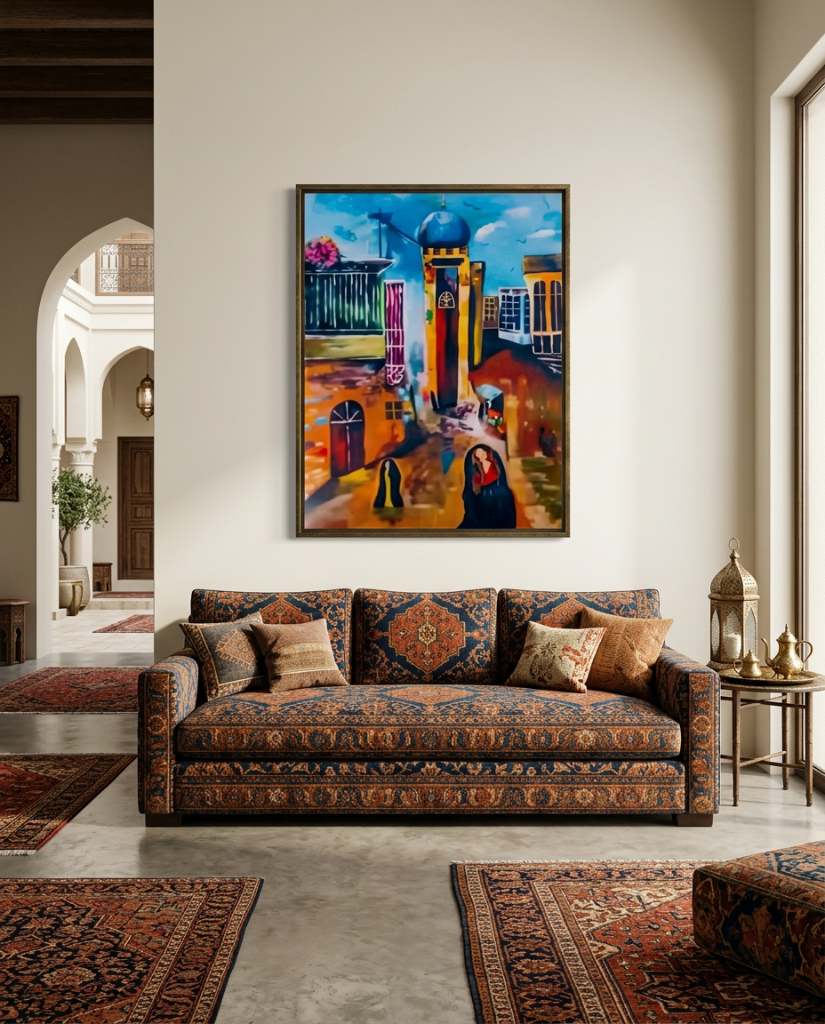
The collector who bought this piece wrote to me after it arrived. They said they had stood in front of it for a long time before they understood what held them. It was not the bougainvillea or the minaret. It was the woman glancing back. They said it felt like she was not looking at the street behind her but at something the viewer could not see, something just past the edge of the frame. They told me they keep the painting in their hallway, so that every time they pass it they catch that glance and feel, for a moment, that they too are being watched from inside a memory. That is the highest thing a buyer can say about a painting: not that it matches the sofa, but that it watches the house back.